
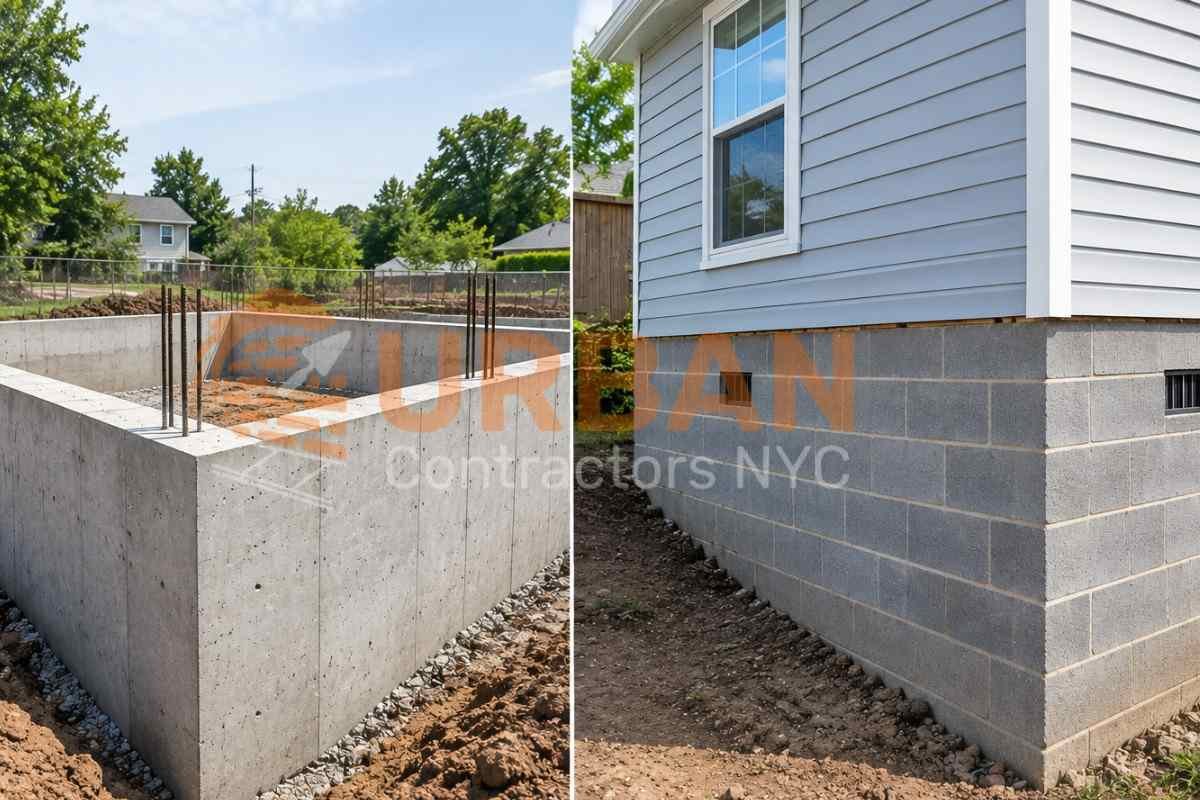
Concrete Foundation vs Block Foundation: What NYC Property Owners Should Know
Poured concrete foundations offer better water resistance and lateral strength, making them the stronger overall choice for most NYC properties, especially in flood-prone or high-water-table areas. Block foundations cost less upfront and are still common in older homes across the boroughs, but they demand more maintenance and are more vulnerable to leaks over time. If you're building new or replacing an existing foundation, the right pick really comes down to your property's location, age, and budget.
Here's what actually separates the two and what it means for owners dealing with New York's particular mix of old housing stock, tight lots and unpredictable soil.
What's the Difference Between a Poured Concrete and Block Foundation
A poured concrete foundation is created by pouring liquid concrete into wooden or metal forms that shape the walls, then letting it cure into one continuous, seamless structure. There are no joints or seams running through the wall, which is a big part of why it performs the way it does.
A block foundation, sometimes called a CMU foundation (short for concrete masonry unit), is built by stacking individual concrete blocks and binding them together with mortar. The blocks are hollow, and contractors often fill the cores with grout and rebar for added strength, particularly along load-bearing sections.
Both are common across New York City, but you'll see the split fall along generational lines. Older rowhouses and prewar buildings were more likely to be built with block, brick, or even rubble stone foundations, while most new construction and recent gut renovations lean toward poured concrete.
Poured Concrete Foundations: Pros and Cons for NYC Properties
Below are some of the advantages and disadvantages of pouring a concrete foundation.
Pros
Poured concrete's biggest selling point is its resistance to water. Because there are no mortar joints for water to work through, it holds up noticeably better in NYC neighborhoods with high water tables, like parts of southern Brooklyn, Staten Island, and low-lying sections of Queens. It also has strong lateral strength, meaning it resists the sideways pressure that wet, expansive soil puts on foundation walls, which matters in a city where storm surge and heavy rain events have become more frequent since Hurricane Sandy.
Poured walls also tend to go up faster once the forms are set, and they generally last longer with less ongoing maintenance. Professionally installed concrete foundations are more likely to last more than a century when they are properly maintained and well waterproofed.
Drawbacks
The tradeoff is cost and access. Pouring concrete requires trucks, pumps, and enough room to set up formwork, which is a real challenge on a narrow NYC lot squeezed between two other buildings. It's also less forgiving if something goes wrong. If the mix isn't right or curing conditions aren't ideal, cracking can happen, and repairing a section of a poured wall usually means dealing with the whole continuous structure rather than swapping out one damaged piece.
Block (CMU) Foundations: Pros and Cons for NYC Properties
Below are some of the advantages and disadvantages of Block Foundation.
Advantages
Block foundations cost less to build, largely because the material and labor requirements are lower than what's needed to truck in and pour wet concrete. They're also more flexible to work with on tight urban sites, since blocks can be carried in and assembled without the same heavy equipment a poured job needs. That's part of why block was such a popular choice in older NYC construction, back when access to big machinery on a crowded block wasn't always realistic.
Repairs can also be more targeted with blocks. If one section is damaged, a mason can sometimes address just that area rather than treating the whole wall as a single unit.
Drawbacks
The mortar joints that make block foundations easier to build are also their weak point. Water can work its way through the seams over time, and the hollow cores inside the blocks can trap moisture if waterproofing wasn't done properly when the foundation went in. In a city with New York's humidity, seasonal freeze-thaw cycles, and older infrastructure, that adds up to more basement moisture complaints in block-foundation buildings than in poured concrete ones.
Block foundations also have less lateral strength than poured concrete unless they're properly reinforced with rebar and grout, which isn't always the case in foundations built decades ago under older code standards.
Cost Comparison: Concrete vs Block Foundations in NYC
Nationally, poured concrete walls run roughly $15 to $40 per square foot, while block (CMU) walls run closer to $15 to $30 per square foot. In New York City specifically, expect the higher end of those ranges and then some, since the city's unionized labor market and dense job sites push prices up across the board. A licensed foundation contractor in NYC typically bills somewhere between $100 and $300 an hour, regardless of which material you choose.
For a full new foundation on a typical NYC rowhouse footprint, poured concrete jobs commonly land in the tens of thousands of dollars once excavation, forming, and finishing are factored in, while a comparable block foundation can come in modestly lower on materials but sometimes close that gap on labor, since laying block by hand is slow, physical work.
The bigger cost difference tends to show up later. Block foundations generally need more frequent waterproofing touch-ups and mortar repointing over their lifespan, so the lower sticker price upfront doesn't always mean lower total cost over 30 or 40 years.
Which Foundation Type Fits NYC's Older Housing Stock
If you own a classic NYC rowhouse or brownstone, there's a good chance your existing foundation isn't concrete or block at all. A lot of pre-1900s buildings across Brooklyn and Manhattan were built on brick or rubble stone foundations, which behave differently from either modern option and often need specialized masons who understand historic construction.
When these older foundations need major repair or replacement, owners typically have a choice to make: rebuild with the same masonry approach to stay consistent with the structure's original engineering, or modernize with poured concrete for better long-term water resistance. Many structural engineers in the city recommend poured concrete for replacement work when the scope allows it, particularly in flood zones or buildings that have had chronic basement water problems.
What NYC Building Code Requires
Regardless of which material you choose, any new foundation or major foundation repair in New York City has to meet the structural requirements laid out in the NYC Building Code, and the work needs sign-off from a Registered Design Professional, either a licensed engineer or architect. The Department of Buildings reviews foundation plans for wall thickness, reinforcement, waterproofing and how the design accounts for local soil conditions before a permit is issued through DOB.
This matters more than people realize when comparing concrete and block. A block foundation isn't automatically non-compliant, but it does need to be properly reinforced and grouted to meet the same structural standards a poured wall would be held to, so cutting corners on materials or labor can create code issues down the line.
Which Foundation Is Right for Your Property
If you're building new construction, doing a gut renovation, or replacing a failing foundation on a coastal or flood-prone lot, poured concrete is generally worth the extra cost for the added water resistance and long-term durability. If you're working with a tighter budget, a site with limited machine access or a smaller structure like a garage or addition, block foundations remain a solid, proven option as long as they're properly waterproofed and reinforced.
The honest answer for most NYC property owners is that the decision shouldn't be made on cost alone. Your soil conditions, flood zone status and the age of the surrounding structure all play a role, which is why it's worth getting a structural engineer's opinion before committing to either material.
Talk to Urban Contractors NYC Before You Decide
Choosing between a concrete or block foundation isn't a decision you want to make based on a general guide alone, since every lot in this city comes with its own soil conditions, water table, and structural quirks. Urban Contractors NYC can assess your property, walk you through which foundation type makes sense for your specific situation and give you a clear, honest estimate before any work begins. Contact us today to schedule a consultation with a team that knows NYC foundations inside and out.