
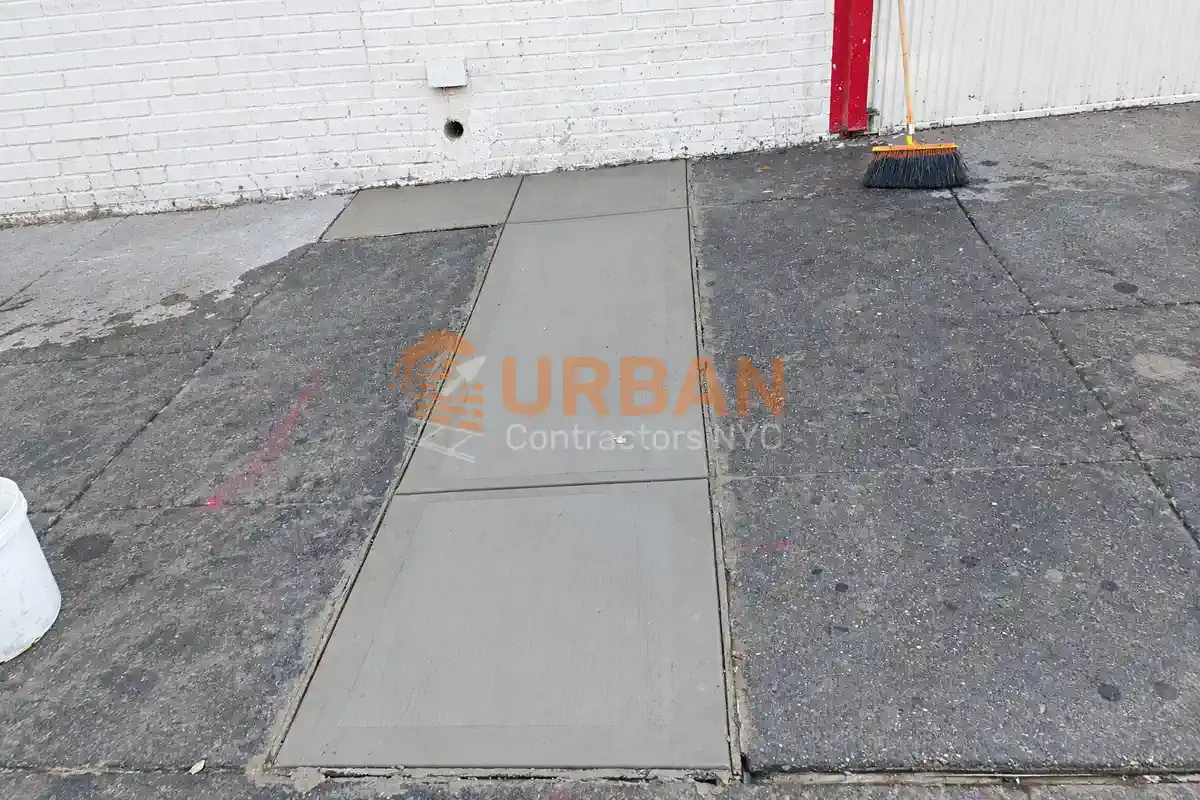
Everything You Need to Know About Concrete Expansion Joints
A concrete expansion joint is a deliberate, full-depth gap between two concrete slabs (or between a slab and a fixed structure like a building wall, column, or curb) that is filled with a compressible material so the concrete can grow and shrink without crushing itself. They matter because concrete is not the frozen, permanent material it looks like. A slab swells in July heat, tightens up in January cold, and shifts a little every time the soil under it moves. Give that movement somewhere to go, and your slab lasts decades. Take that room away, and the pressure comes out as cracks, buckled edges, spalled corners, and slabs that shove into your foundation wall.
If you have ever wondered why sidewalks have those dark, slightly squishy lines running across them at regular intervals, that is the answer. They are not decoration, and they are not seams left over from sloppy pouring. They are the pressure-release valves of the whole slab.
Let's get into it together.
How Does a Concrete Expansion Joint Work?
An expansion joint is a complete separation. That word matters. It runs the full depth of the slab, top to bottom, with nothing crossing it, no concrete bridging underneath, no rebar carrying through, and no bonded contact of any kind. The two sections on either side are genuinely independent pieces that happen to sit next to each other.
Inside that gap sits a compressible filler: closed-cell foam, self-expanding cork, asphalt-impregnated fiberboard, rubber, or a preformed joint material. The filler holds the space open, keeps debris out, and squashes down when the slab expands into it. On top, the last inch or so is usually sealed with a flexible caulk so water cannot pour straight down into the sub-base.
Think of it as an intentional weak link that is strong enough to hold its shape and soft enough to get out of the way. The slab pushes, the filler compresses, and nothing breaks.
Quick answer: A concrete expansion joint is a full-depth gap filled with compressible material that lets a slab expand and contract freely without transferring stress to neighboring slabs or structures.
Why Are Expansion Joints Needed in Concrete?
Concrete moves. That is the whole story in two words, but here is what is actually happening underneath.
1. Thermal expansion and contraction
Concrete expands when it heats and contracts when it cools, and in a place like New York with a 70- to 100-degree swing between a January cold snap and an August heat wave, that movement adds up across a long run of slab. A 40-foot driveway can gain and lose enough length over a year to matter. Expansion joints give that growth a soft place to land.
2. Moisture swelling and drying shrinkage
Fresh concrete shrinks as it cures, then keeps cycling for years afterward, absorbing water and swelling in wet weather, drying out and pulling back in during dry spells. Joints absorb both directions of that motion.
3. Soil movement underneath
Freeze-thaw heave, settlement, tree roots, and vibration from traffic all push the sub-base around. A slab that is rigidly locked to everything around it has to absorb that movement itself. A slab with joints does not.
4. Protecting what the slab touches
This is the reason people underestimate. Without an isolation gap, an expanding slab pushes directly against your foundation wall, your stoop, your garage slab, or a steel column. Concrete generates enormous force when it expands. That force does not politely stop at the edge of the driveway.
5. Keeping cracks off your property and off your liability sheet
Uncontrolled cracking on a sidewalk is not just ugly. In NYC it becomes a trip hazard, a DOT violation, and a potential injury claim against the property owner. Joints are cheap insurance against all three.
How Much Does Concrete Actually Move? The Numbers Behind the Gap
This is the part almost nobody publishes, and it is the part that makes the whole subject click. Concrete movement is not a vague idea. It is a calculable quantity, and the engineering profession has been using the same coefficient for decades.
The coefficient of thermal expansion (CTE) for typical gravel-aggregate concrete is about 5.5 × 10⁻⁶ per °F (roughly 9.9 × 10⁻⁶ per °C). That figure comes out of ACI documentation and is the standard design value used in ACI 318 work. Depending on aggregate type, it ranges roughly 4 to 8 microstrain per °F, which is why AASHTO T-336 exists as a test method for measuring CTE on actual paving mixes.
The formula is simple:
ΔL = α × L × ΔT
Where α is the coefficient (5.5 × 10⁻⁶ /°F), L is the length of the slab, and ΔT is the temperature change.
ACI 224.3R gives the textbook illustration: a 200-foot-long building subjected to a 25°F temperature increase will elongate about 3/8 inch if it is unrestrained. Note the word unrestrained. If it is restrained, that same movement converts into stress, and thermal stress in a restrained member equals the elastic modulus times the strain (σ = E × α × ΔT). Concrete has enormous compressive strength but very little tensile strength, which is exactly why restrained thermal movement shows up as cracking rather than as bulging.
Here is what that math means on real NYC properties, using a conservative 70°F swing between a January low and an August high:
Slab Run | Movement at ΔT = 50°F | Movement at ΔT = 70°F | Movement at ΔT = 100°F |
20 ft (typical single flag run) | 0.066 in | 0.092 in | 0.132 in |
40 ft (two-car driveway length) | 0.132 in | 0.185 in | 0.264 in |
60 ft (mid-block townhouse frontage) | 0.198 in | 0.277 in | 0.396 in |
100 ft (commercial frontage) | 0.330 in | 0.462 in | 0.660 in |
Read the 100-foot row again. A commercial frontage in Brooklyn moves roughly half an inch across a normal year. There is no version of that slab where the movement simply does not happen. It either goes into a joint you planned or into a crack you did not.
Two practical consequences fall out of this table:
● Compression capacity has to match the movement. Asphalt-impregnated fiberboard compresses about 30% of its thickness. A ½-inch board therefore absorbs roughly 0.15 inch. That is fine on a 40-foot run and marginal on a 100-foot run, which is why longer runs get wider joints, more of them, or a higher-compression filler like self-expanding cork.
● Aggregate choice changes the answer. Limestone-aggregate mixes sit at the low end of the CTE range and siliceous gravel mixes at the high end. Two slabs of identical dimensions can move meaningfully different amounts depending on what came out of the plant.
Concrete Expansion Joint Filler: What Actually Goes in the Gap
The filler is the part that determines whether a joint keeps working in year eight or quits in year three. Here is how the common options compare.
Filler / Sealant Type | How It Behaves | Typical Installed Cost | Realistic Lifespan | Best For |
Asphalt-impregnated fiberboard | Rigid board set before the pour; compresses roughly 30% | $2–$4 per linear ft | 10–15 yrs (needs a sealant cap) | Budget work, moderate climates, new pours |
Closed-cell foam (polyethylene) | Highly compressible, does not absorb water | $3–$6 per linear ft | 15–20 yrs | Isolation joints at walls, columns, footings |
Self-expanding cork | Compresses hard, then re-expands to refill the gap when the slab shrinks back | $8–$12 per linear ft | 20+ yrs | Big seasonal swings, freeze-thaw regions like the Northeast |
Polyurethane sealant (over backer rod) | Elastic caulk, stays flexible roughly -40°F to 180°F | $6–$10 per linear ft | 10–15 yrs | The traffic-side seal on driveways and sidewalks |
Silicone sealant (over backer rod) | UV-stable, very long-lived, less abrasion resistant | $4–$7 per linear ft | 15–20 yrs | Exposed exterior joints, NYC DOT sidewalk work |
Rubber / TPV joint systems | Preformed strip that replaces rotted wood filler | Varies by system | 20+ yrs | Retrofitting old driveways with failed wood joints |
Two notes worth more than they seem:
● Wood is not a filler. Plenty of older NYC driveways and walkways have plain wood boards sitting in the joints because that is what was cheap at the time. Wood rots, shrinks, and leaves an open channel for water. If you are pulling black crumbling material out of a joint with a screwdriver, that is what you are looking at, and it needs replacing.
● Sealant needs a backer rod. A foam backer rod sits under the caulk to control the depth of the sealant and stop it from bonding to the bottom of the joint. Sealant bonded on three sides cannot stretch properly and tears within a couple of seasons. This is the single most common DIY mistake in joint work.
Concrete Slab Expansion Joint Detail
If you want the joint to actually function, the geometry matters as much as the material. Here is the detail a competent crew works to.
● Width: ½ inch is the standard for slab-to-structure isolation. ¼ inch is used on many sidewalk applications. Wider joints are used on long runs and heavy commercial slabs.
● Depth: full depth of the slab. Not most of it. If concrete bridges under the filler, the joint does nothing.
● Filler height: the compressible filler is typically installed to within about 1 inch of the finished surface.
● Sealant reservoir: that top inch gets a backer rod and a flexible sealant, tooled slightly concave and recessed just below the surface so foot traffic and snow shovels do not tear it out.
● Reinforcement: no rebar, no mesh, and no dowels carry through a true expansion joint. If steel crosses it, you have built a very expensive construction joint instead.
● Sub-base: compacted, drained, and continuous under both slabs so water passing the joint does not undermine one side.
Spacing: How Far Apart Do They Go?
Here is where most articles go wrong, so read this part carefully. Expansion joints are not placed on a regular grid. They go where the slab meets something that will not move with it, plus at long intervals on extended runs.
● Isolation/expansion joints: at every fixed object, building wall, column, footing, curb, drain, light pole, garage slab, adjacent sidewalk, and at changes in slab direction or geometry. On long exterior flatwork, additional full-depth joints are typically placed every 20 to 40 feet depending on the spec.
● Control (contraction) joints: these are the ones that follow a grid. The industry rule of thumb is spacing in feet equal to 24 to 36 times the slab thickness in inches, which works out to roughly 8 to 12 feet for a 4-inch residential slab and 12 to 18 feet for a 6-inch commercial slab. Keep panels close to square, with the long side no more than about 1.5 times the short side.
● Control joint depth: at least one quarter of the slab thickness, 1 inch on a 4-inch slab, and saw-cut within roughly 4 to 12 hours of finishing, sooner in hot, dry weather.
Types of Concrete Expansion Joints
The term “expansion joint” gets used loosely for four different things. Knowing which is which is genuinely useful when you are reading an estimate.
● Isolation joints. The most common type on residential and commercial flatwork. They separate a slab from a fixed element, a foundation wall, a column, a stoop, or a manhole. Filled with compressible material, no reinforcement crossing.
● Contraction joints (control joints). Tooled grooves or saw cuts that create a deliberate weak plane so shrinkage cracking happens in a straight line where you chose, rather than wandering across the slab. Partial depth, not full depth.
● Construction joints (cold joints). Where one day's pour stops and the next begins. Sometimes keyed or doweled to transfer load, sometimes not. Planned stopping points, not movement joints, though they still need sealing.
● Structural and bridge expansion joints. Engineered assemblies with steel, elastomeric, or modular components, used on bridges, parking decks, and large buildings where movement is measured in inches rather than fractions. Different world, different budget, and always engineer-specified.
Where Are Expansion Joints Used?
Almost anywhere concrete meets something else or runs long enough to move noticeably:
● Sidewalks and walkways: at the building line, at curbs, at driveway aprons, and at set intervals along the run
● Driveway: where the driveway meets the garage slab, the sidewalk, and the street
● Patios and pool decks: at the house wall and around any fixed feature
● Concrete steps and stoops: where the steps meet the walkway and the building
● Garage and basement floors: around columns, at the perimeter wall, and at floor drains
● Foundations and retaining walls: at changes in geometry and along long continuous runs
● Parking structures, warehouses, and industrial slabs, where forklift traffic makes joint edge failure expensive fast
● Bridges, highways, and rail platforms, where thermal movement and vibration are constant
Expansion Joint vs Control Joint: The Difference That Actually Matters
year three. Here is how the common options compare.
Filler / Sealant Type | How It Behaves | Typical Installed Cost | Realistic Lifespan | Best For |
Asphalt-impregn-ated fiberboard | Rigid board set before the pour; compresses roughly 30% | $2–$4 per linear ft | 10–15 yrs (needs a sealant cap) | Budget work, moderate climates, new pours |
Closed-cell foam (polyethylene) | Highly compressible, does not absorb water | $3–$6 per linear ft | 15–20 yrs | Isolation joints at walls, columns, footings |
Self-expanding cork | Compresses hard, then re-expands to refill the gap when the slab shrinks back | $8–$12 per linear ft | 20+ yrs | Big seasonal swings, freeze-thaw regions like the Northeast |
Polyurethane sealant (over backer rod) | Elastic caulk, stays flexible roughly -40°F to 180°F | $6–$10 per linear ft | 10–15 yrs | The traffic-side seal on driveways and sidewalks |
Silicone sealant (over backer rod) | UV-stable, very long-lived, less abrasion resistant | $4–$7 per linear ft | 15–20 yrs | Exposed exterior joints, NYC DOT sidewalk work |
Rubber / TPV joint systems | Preformed strip that replaces rotted wood filler | Varies by system | 20+ yrs | Retrofitting old driveways with failed wood joints |
The practical takeaway: a control joint cannot do an expansion joint's job. If a slab butts up against your foundation wall and someone put a saw cut there instead of a full-depth isolation joint, that slab will eventually push on your wall. Thermal force has nowhere else to go.
Most of what people point at on a residential driveway and call “expansion joints” are actually contraction joints. The real expansion joints are the ones at the garage, the sidewalk, and the street.
The Standards Your Contractor Should Be Working To
If you want a fast way to tell whether an estimate came from someone who knows the work, ask which standards their joint detail follows. Here are the documents that actually govern this, and what each one covers.
Standard | Issuing Body | What It Governs |
ACI 224.3R-95 (R2013) -Joints in Concrete Construction | American Concrete Institute | The master reference on joint design, construction, and maintenance across buildings, bridges, slabs-on-grade, walls, and pavements |
ACI 224R - Control of Cracking in Concrete Structures | American Concrete Institute | Causes and control of cracking; the “why” behind joint spacing |
ACI 302.1R - Guide to Concrete Floor and Slab Construction | American Concrete Institute | Slab-on-grade jointing, saw-cut timing, reinforcement across joints |
ACI 360R - Design of Slabs-on-Ground | American Concrete Institute | Contraction joint spacing at 24–36× slab thickness, panel aspect ratios |
ACI 504R - Sealing Joints | American Concrete Institute | Sealant material selection and joint sealing practice |
ACI 318 - Building Code Requirements for Structural Concrete | American Concrete Institute | Design values including the 5.5 × 10⁻⁶ /°F thermal coefficient |
NRMCA CIP 6 - Joints in Concrete Slabs on Grade | National Ready Mixed Concrete Association | The industry's plain-language jointing guidance, aligned with ACI and IBC criteria |
ASTM D1751 | ASTM International | Preformed expansion joint filler, bituminous type (asphalt-impregnated fiberboard) |
ASTM D1752 | ASTM International | Preformed sponge rubber, cork, and recycled PVC nitrile expansion joint fillers |
ASTM C920 | ASTM International | Elastomeric joint sealants, the spec your polyurethane or silicone caulk should meet |
ASTM C1193 | ASTM International | Standard guide for use of joint sealants, including backer rod sizing and joint geometry |
AASHTO T-336 | AASHTO | Test method for coefficient of thermal expansion of hydraulic cement concrete |
IBC / NYC Construction Codes | ICC / NYC DOB | Building-level movement joint requirements and structural concrete provisions |
Two ratios from these documents are worth memorizing because they get violated constantly on residential work:
● Panel aspect ratio: ACI guidance keeps slab panels close to square, with the longest dimension no more than about 1.5 times the shortest. Long, narrow panels crack diagonally regardless of how well the joints were cut.
● Saw-cut window: control joints must be cut within roughly 4 to 12 hours of finishing per ACI, and often within 2 to 4 hours in hot, dry weather. Cut late, and the shrinkage stress has already found its own crack.
Expansion Joints on NYC Sidewalks: What the City Requires
This one is specific and worth knowing if you own property in the five boroughs, because DOT inspectors check it.
NYC DOT sidewalk standards call for expansion joints at 20-foot intervals, with filler material placed to the full depth of the sidewalk, and all expansion joints recessed and sealed. Sidewalk flags are to be 5 feet by 5 feet where feasible, and flags with substantial defects have to be replaced outright, patching individual flags is not permitted.
The city's specification also gets granular on dimensions: joints are generally ¼ inch wide, except along the building line, where they are ½ inch, filled with preformed joint filler to within 1 inch of the surface, with that top inch sealed using a cold-application silicone sealer over an approved backer rod, in a charcoal color that matches adjacent work.
The Code Citations Behind Those Numbers
For anyone who wants the primary sources rather than a contractor's paraphrase, here is where each requirement actually lives.
Requirement | Figure | Where It Comes From |
Sidewalk slab thickness | 4 in. single course | 34 RCNY § 2-09(f) |
Foundation beneath sidewalk | 6 in. | 34 RCNY § 2-09(f) |
Slab thickness at driveways and corner quadrants | 7 in. | 34 RCNY § 2-09(f) |
Expansion joint interval | Every 20 ft | NYC DOT Street Works Manual, Sidewalk Repairs |
Expansion joint filler depth | Full depth of sidewalk | NYC DOT Street Works Manual |
Joint width, general | ¼ in. (tooled joints may be ¼ or ½ in.) | NYC DOT Standard Highway Specifications § 4.13 |
Joint width at the building line | ½ in. | NYC DOT Standard Highway Specifications § 4.13 |
Filler height below surface | Filled to within 1 in. of surface | NYC DOT Standard Highway Specifications § 4.13 |
Top-inch seal | Type 2 cold-application silicone sealer over approved backer rod / bond breaker | NYC DOT Standard Highway Specifications § 2.22 and § 4.13 |
Curb expansion joints | ¼ in. wide, approved premolded filler, cut flush | NYC DOT Specification Bulletin SB 24-003 |
Standard flag size | 5 ft × 5 ft where feasible | NYC DOT Street Works Manual |
Pigmented concrete with saw-cut joints | Required in C4-4 through C4-7, C5, C6 districts | 34 RCNY § 2-09(f) |
Owner liability for the sidewalk | Owner maintains abutting sidewalk | NYC Admin. Code § 7-210 |
Owner obligation to repair | Owner repairs at own cost and expense | NYC Admin. Code § 19-152 |
What Counts as a “Substantial Defect” in NYC
This is the threshold that turns a neglected joint into a violation. Under NYC Administrative Code § 19-152 and 34 RCNY § 2-09(f)(5), a substantial defect includes:
● A missing flag or sidewalk never built
● A flag cracked badly enough that pieces can be loosened or readily removed
● An undermined flag with a visible void beneath it, or a loose flag that rocks or seesaws
● A trip hazard where the vertical differential between adjacent flags is ½ inch or greater, or where a flag has a surface defect 1 inch or greater in all horizontal directions and ½ inch or more in depth
● Improper slope, a flag that does not drain toward the curb, or a cross slope exceeding standards
● Hardware or appurtenances not flush within ½ inch of the sidewalk surface
Trace those thresholds backward, and the connection to joints is direct. An unsealed joint lets water under the slab, water washes out the sub-base, the flag settles, and the vertical differential crosses the ½-inch line. That is the mechanism behind a large share of NYC sidewalk violations, and it starts with a joint that was $8 a linear foot to seal.
Why does this matter to you rather than to your contractor alone? Because in New York the property owner is responsible for the sidewalk. A joint detail that does not meet spec is a joint that fails early, and a failed joint produces the exact defects, cracked flags, trip hazards, and uneven edges that generate violations and liability. Getting the joints right the first time is significantly cheaper than a violation removal plus a repour.
How Much Does a Concrete Expansion Joint Cost?
Prices vary by borough, access, joint condition, and material, but here are realistic 2026 ranges to plan against.
Scope | Typical Range |
DIY materials (filler board + sealant) | $3–$8 per linear ft |
Professional joint sealing / re-caulking | $5–$12 per linear ft |
Professional joint installation in new flatwork | $8–$18 per linear ft |
Full joint replacement (cut out, prep, refill, seal) | $25–$50 per linear ft |
Structural / parking deck joint work | $70–$110+ per linear ft |
Typical residential re-caulk minimum charge | A few hundred dollars |
For scale: a standard two-car driveway around 20 by 40 feet usually needs somewhere between 120 and 160 linear feet of joints once you count perimeter isolation plus interior cuts. At professional rates that land roughly in the $960 to $2,880 range for a complete job, and considerably less if you are only resealing existing joints rather than rebuilding them.
Three things push the number up: joint width and depth, how much old failed material has to be ground and cut out first, and access. Narrow city lots, tight side yards, and slabs that a truck cannot reach all add labor hours.
Worth comparing against: replacing a slab that failed because its joints were skipped or filled with rotted wood costs several times what the joint work would have cost. Sealing is maintenance. Slab replacement is a capital expense.
How to Tell Your Expansion Joints Have Failed
Walk your driveway or sidewalk and look for:
● Filler that is crumbling, spongy, or missing entirely, leaving an open channel
● Sealant that has pulled away from one side of the joint (adhesion failure) or split down the middle (cohesion failure)
● Weeds or grass growing out of the joint, which means it is open all the way to soil
● Spalling or chipped edges on either side of the joint, a sign the two slabs are grinding against each other
● Slabs at different heights across a joint, which usually means water has been washing out the sub-base
● Joints that have closed up completely with no visible gap left, meaning there is no expansion room remaining
● A slab that has visibly shifted toward the house or the curb
That water point deserves emphasis. Because expansion joints are gaps by design, an unsealed one funnels rainwater and snowmelt straight under the slab, where it erodes the soil supporting it. Over a few seasons that produces the settled, uneven slabs that cause trip hazards. Sealing the joint is not a cosmetic upgrade; it is what keeps the ground under your concrete intact.
Maintenance Schedule
● Every spring and fall: clear debris from joints, check sealant for splits or pull-away
● Every 2–3 years: touch up any short sections of failed sealant before water gets in
● Polyurethane sealant: plan on full replacement around year 7 to 10
● Silicone sealant: plan on year 15 to 20
● After any major freeze-thaw winter: inspect joints at the building line and garage apron first, since those take the most force
● Never: fill an expansion joint with rigid mortar, concrete patch, or non-flexible filler. A rigid fill turns a working joint into a solid bridge and guarantees a crack somewhere nearby.
Frequently Asked Questions
Do expansion joints need to go all the way through the slab?
Yes. Full depth is what makes it an expansion joint. If concrete connects underneath the filler, the two slabs are still locked together and the joint is decorative.
How far apart should expansion joints be on a sidewalk?
NYC DOT specifies 20-foot intervals for expansion joints, in addition to the closer-spaced scored or saw-cut control joints that define individual flags.
Can I fill an expansion joint with concrete or mortar?
No. Rigid material removes the compression room the joint exists to provide, and the resulting pressure will crack the slab somewhere it was not planned.
What is the best filler for a cold climate like New York?
Self-expanding cork or closed-cell foam for the body of the joint, topped with a polyurethane or silicone sealant over a backer rod. Cork in particular handles large seasonal swings well because it re-expands when the slab pulls back in winter.
Is joint sealing a DIY job?
Small touch-ups on a couple of joints, yes — expect $5 to $12 in materials for one or two cracks. Full joint replacement involves cutting out old material, cleaning to a bondable surface, sizing a backer rod correctly, and tooling the sealant. Done wrong, it fails within a season, and on a NYC sidewalk it can leave you non-compliant.
Will new expansion joints fix a cracked slab?
No. Joints prevent future cracking; they do not repair existing damage. A cracked slab needs assessment first, since the fix might be joint work, might be slab leveling, or might be replacement of the affected flags.
How much does a 40-foot concrete driveway actually expand in a New York summer?
Using the standard coefficient of 5.5 × 10⁻⁶ per °F, a 40-foot slab moves about 0.185 inch across a 70°F seasonal swing. Small in absolute terms, more than enough to spall a slab edge if there is nowhere for it to go.
Which ASTM standard should my joint filler meet?
ASTM D1751 for bituminous fiberboard, ASTM D1752 for cork, sponge rubber, and PVC nitrile fillers, and ASTM C920 for the elastomeric sealant on top. If a product does not name one of these on the label, ask why.
What is the difference between an expansion joint and an isolation joint?
In practice on residential work, very little isolation joint is the more precise term for the full-depth gap separating a slab from a fixed structure, and it is the type most homeowners actually have.
The Bottom Line
Expansion joints are the least glamorous part of a concrete job and the part that decides how long the job lasts. They cost a small fraction of the pour, and they prevent the two most expensive outcomes: a cracked slab you have to replace and a slab that transfers its movement into your building.
If your joints are crumbling, open to soil, sealed with the wrong material, or missing where the slab meets your foundation, that is worth addressing before the next freeze-thaw cycle rather than after it.
Urban Contractors NYC handles concrete sidewalk, driveway, step, and foundation work across Manhattan, Brooklyn, Queens, and the Bronx, including DOT-compliant joint detailing and violation removal. Call 718-313-0260 for a free on-site assessment of your joints and slab condition.
References and Primary Sources
● American Concrete Institute - ACI 224.3R-95 (Reapproved 2013), Joints in Concrete Construction
● American Concrete Institute - ACI 224R, Control of Cracking in Concrete Structures
● American Concrete Institute - ACI 302.1R, Guide to Concrete Floor and Slab Construction
● American Concrete Institute - ACI 360R, Design of Slabs-on-Ground
● American Concrete Institute - ACI 504R, Guide to Sealing Joints in Concrete Structures
● National Ready Mixed Concrete Association - CIP 6, Joints in Concrete Slabs on Grade
● ASTM International - D1751, D1752, C920, C1193
● AASHTO - T-336, Coefficient of Thermal Expansion of Hydraulic Cement Concrete
● New York City Department of Transportation - Standard Highway Specifications, Section 4.13 (Sidewalk, Concrete) and Section 2.22 (Joint Sealer)
● New York City Department of Transportation - Specification Bulletin SB 24-003, Corner Curb
● New York City Department of Transportation - Street Works Manual, Chapter 4.4, Sidewalk Repairs
● Rules of the City of New York - 34 RCNY § 2-09, Sidewalk, Curb and Roadway Work
● New York City Administrative Code - § 7-210 and § 19-152